Sensory Processing vs Autism: Key Differences
Child Development, Sensory Processing, Autism
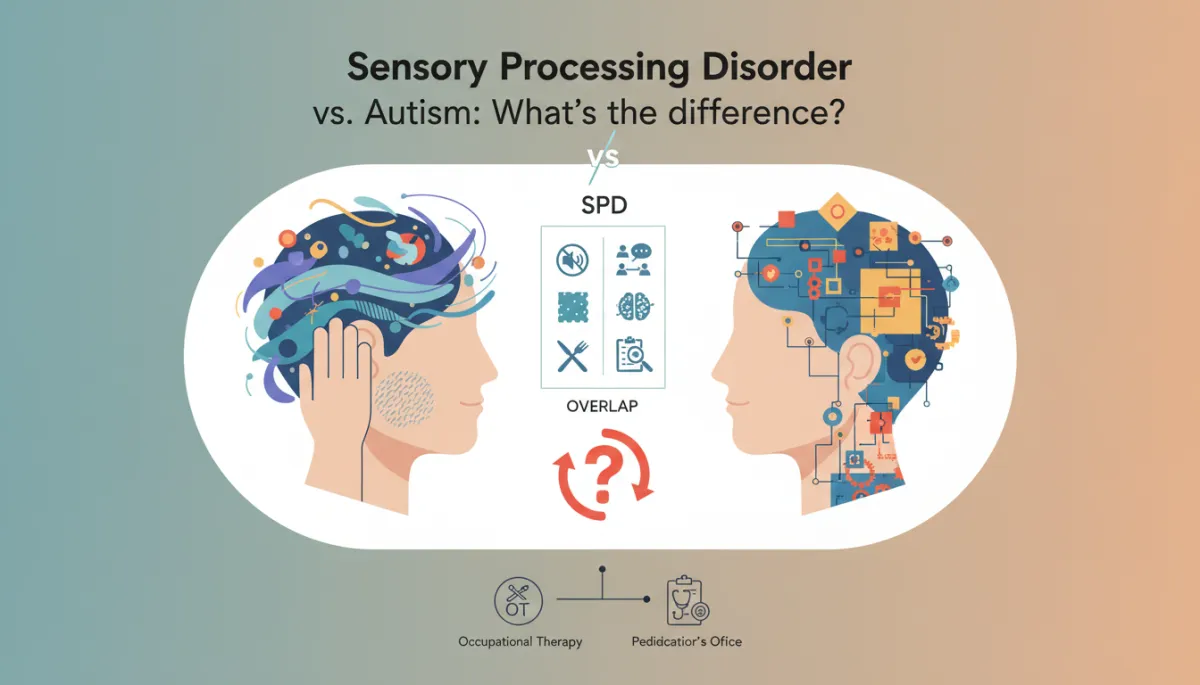
Sensory Processing Disorder vs. Autism: What’s the Difference?
Sensory processing difficulties and autism often show up together, but they are not the same condition. Understanding how they overlap—and how they differ—helps parents decide when to seek an occupational therapy evaluation, when to raise broader developmental questions with a pediatrician, and why sensory challenges deserve support whether or not a child has an autism diagnosis.
Sensory Processing vs. Autism: The Core Distinction
Sensory processing describes how the brain receives, interprets, and responds to information from the senses—sound, touch, movement, vision, taste, smell, and internal body signals. Some children are highly sensitive; others seem to miss or crave certain sensations. These patterns are often described as sensory hyperreactivity (over-responsiveness), hyporeactivity (under-responsiveness), or unusual interest in sensory experiences. Research consistently shows that these differences can significantly affect daily life, regardless of diagnosis (Autism Speaks; SPD Star Institute).
Autism, by contrast, is a neurodevelopmental condition defined by broader criteria. Diagnostic manuals such as the DSM‑5 describe autism in terms of:
Persistent differences in social communication and interaction, and
Restricted or repetitive patterns of behavior, interests, or activities, which can include sensory features.
Sensory responses can be one feature of autism, but they are only one part of a larger developmental picture. This is the key difference: sensory differences alone do not mean a child has autism.
Key Takeaways at a Glance
Sensory processing difficulties and autism are not the same thing. They can co‑occur, but each has distinct criteria and implications.
Sensory differences alone do not mean a child has autism. Many children have strong sensory preferences without meeting criteria for autism.
Sensory responses can be one feature of autism. In autism, sensory hyperreactivity, hyporeactivity, or unusual sensory interests fall under the restricted and repetitive behavior criteria.
Children without autism can also experience significant sensory difficulties. These children may still struggle with clothing, noise, grooming, or feeding, even without any other diagnosis.
Autism evaluations look at development beyond sensory processing. Clinicians consider language, play, social interaction, behavior patterns, and history, not just sensory checklists.
Occupational therapy can address functional sensory challenges regardless of whether a child has an autism diagnosis. The focus is on everyday participation and safety, not labels alone.
Why Parents Often Confuse Sensory Processing and Autism
Parents usually notice behaviors long before they see a diagnostic report. This is where the overlap becomes confusing. An autistic child might:
Cover their ears in noisy places or avoid certain environments entirely.
Refuse particular clothing textures or become distressed by tags and seams.
Seek constant movement, spinning, or jumping, or enjoy repetitive visual or tactile experiences.
Have strong food preferences related to texture, temperature, or mixed foods touching on the plate.
A child who is not autistic may do some of these exact same things. This is why there’s overlap in individual behaviors between autistic and non‑autistic children. The behavior alone does not tell you whether autism is present. What matters is the broader developmental pattern and how consistently these differences appear across situations and over time.
💡 Pro Tip: If you are new to the concept of sensory processing, the guide to Sensory Processing Disorder in children offers a clear overview of how sensory sensitivities and sensory seeking can affect children with and without other developmental diagnoses.
The Biggest Difference: Sensory Features vs. a Whole Developmental Profile
Autism is defined by a whole profile of development, not by one behavior type. Sensory responses are one possible part of that profile. In current research, clinicians and scientists describe multiple sensory “phenotypes” within autism—groups of individuals who share similar sensory response patterns—but these sit alongside differences in social communication, play, and behavior (e.g., JADD 2026 sensory subtype studies; Current Psychiatry Reports 2026 review).
In other words:
Sensory differences alone do not equal autism.
If you are concerned about autism, it is important to step back and look at the broader developmental picture with your child’s pediatrician or another appropriately qualified professional, rather than trying to decide based only on a sensory checklist. Autism evaluations consider:
How your child communicates and plays with others.
How they use eye contact, gestures, and shared attention.
The presence of repetitive movements, intense interests, or rigid routines.
Their developmental history across language, motor, and social milestones.
When a Child Is Extremely Sensitive to Sounds or Clothing
Sensitivity to sound, touch, food textures, or grooming tasks can occur in both autistic and non‑autistic children. A child might:
Cry or panic at hand dryers, blenders, or vacuum cleaners.
Refuse socks, jeans, or certain fabrics, or insist on wearing the same soft clothing daily.
Gag with lumpy textures or mixed foods, even if they are hungry.
Struggle with hair brushing, nail trimming, or toothbrushing far beyond what is typical for their age.
Rather than trying to diagnose autism from these behaviors alone, consider two questions:
How intense and frequent are the sensory reactions?
Are there other developmental concerns—such as communication, play, or social interaction differences?
For parents whose main concern is sensitivity, Why is my child so sensitive to sounds, clothing, food, or touch? explains how to distinguish everyday preferences from sensory reactions that begin to interfere with daily activities.

The same sensory behavior can appear in autistic and non‑autistic children alike.
How Occupational Therapy Fits In—With or Without Autism
Occupational therapy (OT) is not limited to children with autism. Occupational therapy focuses on functional need. The central question is not “Does my child meet criteria for autism?” but “Are sensory, motor, self‑care, regulation, play, feeding, or school participation challenges interfering with everyday life?”
A child may benefit from an OT evaluation when:
Getting dressed, grooming, or bathing regularly end in tears or avoidance because of sensory discomfort.
Noise, crowds, or busy environments make it difficult to attend school, childcare, or family activities.
Feeding challenges linked to texture or smell are limiting nutrition or family meals.
The child’s need for movement or sensory input is so high that safety or learning is affected.
At Kerrie Rowe OT, the approach is to focus on the child’s functional sensory and occupational needs, while also recognizing when broader developmental concerns should be discussed with an appropriate diagnostic provider.
Should You Get an OT Evaluation?
If your primary concern is sensory processing and everyday participation, an OT evaluation can provide practical, individualized recommendations. If you are trying to decide whether the difficulties have become significant enough to evaluate, Does my child need an occupational therapy evaluation for sensory issues? outlines specific examples of when it is helpful to take a closer look.
Frequently Asked Questions
Does having sensory issues mean my child is autistic?
No. Sensory differences alone do not mean a child has autism. Many children have strong sensory preferences, sensitivities, or seeking behaviors without meeting criteria for autism. The diagnosis depends on the broader social communication and behavior profile, not on sensory features in isolation.
Are sensory issues part of autism?
They can be. Sensory hyperreactivity, hyporeactivity, or unusual sensory interests are one component of autism’s restricted or repetitive behavior criteria. Recent research highlights how these patterns can relate to sleep, emotional regulation, and participation in daily activities, but they are still one piece of a larger diagnostic picture.
Can a child have sensory processing problems without autism?
Yes. Children without autism can also experience significant sensory difficulties. Some may be described as having Sensory Processing Disorder (SPD), even though SPD is not a standalone diagnosis in manuals like the DSM‑5. These children can still benefit from occupational therapy, environmental adjustments, and supportive strategies at home and school.
Should I see an OT or pediatrician first?
If you are concerned about autism or your child’s broader development, start by discussing those concerns with your pediatrician or another appropriately qualified professional. They can help decide whether a formal autism evaluation is indicated. If the primary concern involves functional sensory, motor, self‑care, or participation difficulties, an occupational therapy evaluation may also be appropriate—either in parallel with, or independent from, an autism assessment.
Final Thoughts
Sensory processing difficulties and autism are related but distinct. Sensory differences can be part of autism, but they are not enough on their own to define it. Focusing on how your child functions in daily life—and seeking support that targets those real‑world challenges—ensures that sensory needs are addressed whether or not an autism diagnosis is present.