School vs. Private OT Evaluations: Key Differences
Pediatric OT, School OT, Private OT Evaluations, IEEs
School OT Evaluation vs. Private OT Evaluation: What’s the Difference?
When a child is struggling with handwriting, attention, or everyday tasks, families often hear two terms: school occupational therapy (OT) evaluation and private OT evaluation. Both are valuable, but they serve different purposes, answer different questions, and follow different rules. Understanding these differences can help you choose the option that best fits your child and your goals.
School OT vs. Private OT: Different Questions, Different Focus
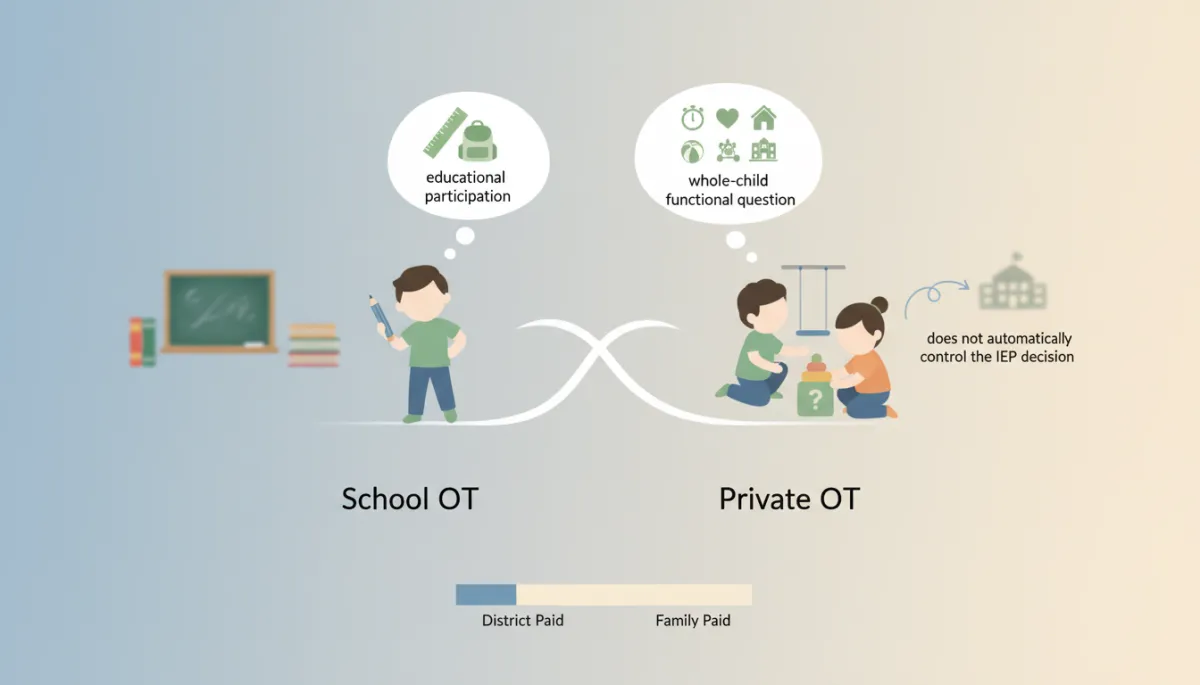
A school OT evaluation focuses on educational participation and whether OT may be required as a related service. In other words, school OT asks an educational question: does the child need OT to access and make progress in their educational program? A private OT evaluation can take a broader look at the child across school, home, self-care, routines, play, and community participation. This allows the therapist to ask a whole-child functional question: where is the child having difficulty in daily life, and how can OT help?
Key Takeaways for Families Comparing Options
School OT asks an educational question; private OT can ask a whole-child functional question.
Both may assess handwriting, fine motor skills, visual-motor integration, sensory processing, and motor coordination, even though they interpret results through different lenses.
The district pays for its evaluation; a private evaluation is typically family-paid or funded through private insurance or other payers.
A child may benefit from private OT even if they do not receive school OT as a related service.
A private report can be shared with the school, but it does not automatically control the Individualized Education Program (IEP) decision; the IEP team must consider it alongside other data.
Disagreement with a district evaluation may make an Independent Educational Evaluation (IEE) relevant, rather than simply repeating similar private testing.
Side-by-Side Comparison: School OT vs. Private OT Evaluation
FeatureSchool OT evaluationPrivate OT evaluation Primary focus Educational access and participation Broader occupational performance across settings Initiated through School evaluation process and special education procedures Family directly contacts the provider or clinic Typical payer School district Family or private payer (sometimes insurance) Home routines Included when educationally relevant May be a major focus of the evaluation Service decision IEP team determines if OT is needed as a related service Family and private provider decide on goals and treatment plan
Do School and Private OTs Use Different Tests?
Sometimes, but not necessarily. The same standardized tool may be used in either setting. What changes is why it is selected, what other data are gathered, and how the results are interpreted functionally. In school, scores are tied back to classroom participation and curriculum demands. In private practice, results may be linked to dressing, feeding, play, community outings, and family priorities.
Why Might Two Evaluators Reach Different Conclusions?
Evaluators may be answering different questions. A private therapist may conclude that OT could help with daily functioning, while the school team may conclude that OT is not required as a related service within the educational program. This does not always mean one of them is “wrong”; it reflects the different decision frameworks used in educational and medical or private systems.
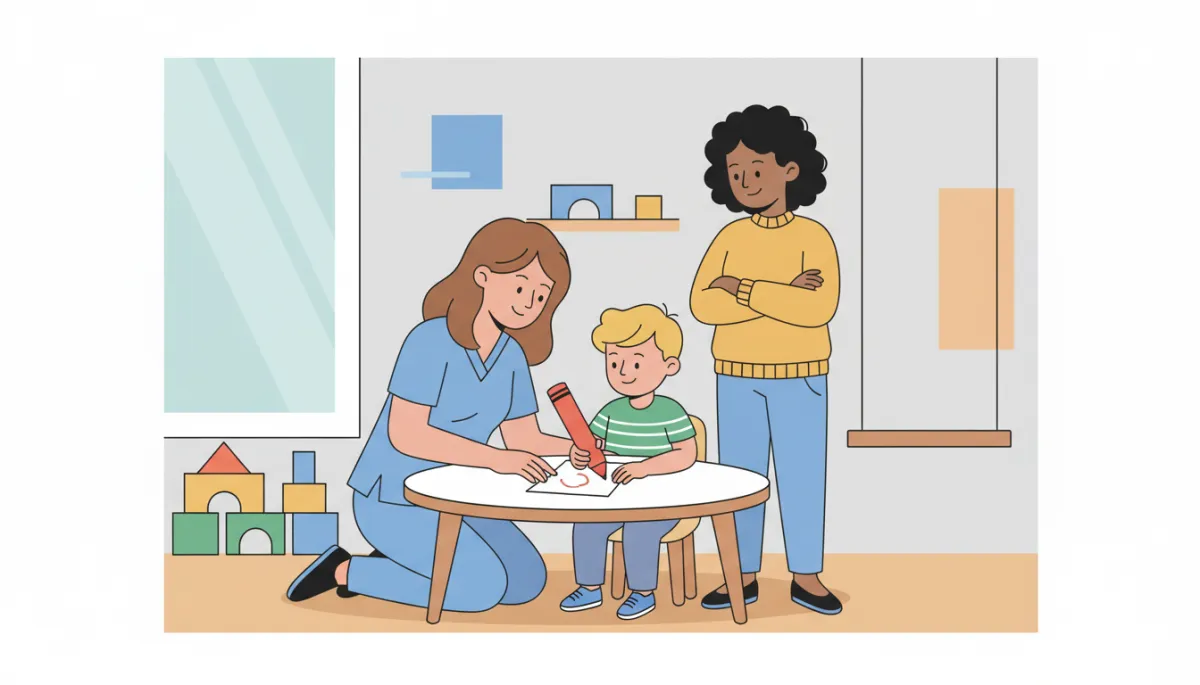
School and private OT evaluations can be complementary when each answers a clear question.
Can My Child Receive Both School and Private Evaluations?
Yes. Many families pursue both. The key is to avoid unnecessary duplication and make sure each evaluation answers a distinct question. A private evaluation can explore home routines and community participation, while the school evaluation addresses access to the curriculum. If the school has already evaluated your child and you disagree, What if I disagree with my child’s school OT evaluation? will help you determine whether an IEE is more appropriate than another privately paid assessment.
What Does Kerrie Rowe OT Include in a Private Assessment?
At Kerrie Rowe OT, the evaluation may incorporate parent interview, relevant school information, standardized measures, clinical observation, functional tasks, work samples, and a written roadmap. The exact process is tailored to the child rather than copied from a universal test battery. This individualized approach supports clearer recommendations for home, school collaboration, and community participation.
📌 Comparison with buying intent: If your primary goal is school-based support, a district evaluation is the required first step. If you are seeking broader help with home routines, self-care, and community life—or want more time for discussion and coaching—a private OT evaluation may be the more appropriate investment.
Overview of Pediatric OT Evaluation Options: School OT, Private OT, and IEEs
Families typically have three main pathways: a school OT evaluation through the district, a private OT evaluation arranged directly with a provider, and an Independent Educational Evaluation (IEE) when there is disagreement with the school’s assessment. For an overview of all three pathways, read Pediatric OT evaluation options: School OT, private OT, and IEEs before deciding whether school, private, or independent educational evaluation best matches your goal.
Frequently Asked Questions
Is a private OT evaluation more comprehensive?
Not automatically. It often has broader scope, but quality depends on the evaluator and the questions being addressed. A focused school evaluation can be very thorough within its educational mandate, while a private evaluation can explore more life areas when that is your priority.
Can a child qualify for private OT but not school OT?
Yes. The systems use different purposes and decision frameworks. A child may have meaningful challenges with dressing, feeding, or play that warrant private OT, while still being able to access their educational program without school-based OT as a related service.
Can the school use my private OT report?
Yes. You can share a private report with the school team. The school must consider it, but is not automatically required to follow every recommendation. The IEP team will weigh the private report alongside classroom data, teacher input, and school-based assessments.
Does the school need to evaluate home concerns?
School evaluation focuses on educationally relevant needs. Broader home concerns, such as morning routines, community outings, or extracurricular participation, may be better addressed privately unless they directly affect educational access and progress.
What if I disagree with the school evaluation?
If you disagree with the school’s OT evaluation, investigate the IEE process before paying for duplicative testing. Families have specific procedural safeguards, and an IEE may be an appropriate next step when you believe the district’s assessment does not fully capture your child’s needs.
Educational Notice
This page provides general information about pediatric occupational therapy evaluations and special education. It is not legal advice. Families should review their procedural safeguards and consult a qualified special education attorney or advocate when legal guidance is needed.