Private vs. School OT Evaluations: Your Options
Pediatric OT, School OT vs. Private OT, Evaluations
Can I Get a Private OT Evaluation Instead of a School OT Evaluation?
Many families wonder whether they can choose a private occupational therapy (OT) evaluation instead of relying solely on the school. Understanding your options helps you make a confident, informed decision that fits your child’s needs and your family’s goals.
Can I Get a Private OT Evaluation Instead of a School OT Evaluation?
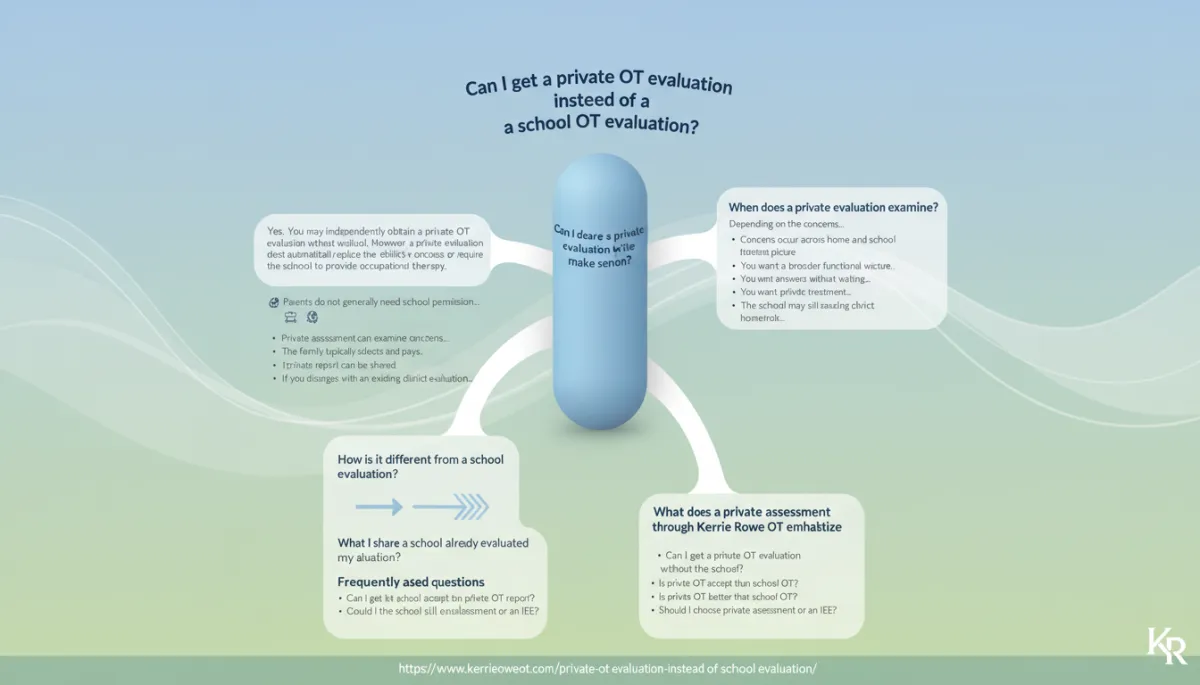
Yes. You may independently obtain a private OT evaluation without waiting for the school. Parents do not generally need school permission to obtain a private OT evaluation, and families may contact a private occupational therapist directly. However, a private evaluation does not automatically replace the district’s evaluation process or require the school to provide occupational therapy. The school may still conduct its own evaluation and maintain responsibility for determining eligibility and services under special education law.
When Does a Private Evaluation Make Sense?
A private OT evaluation can be especially helpful when concerns occur across home and school, and you want a broader functional picture of your child’s strengths and challenges. Families often pursue private assessment when they want answers without waiting for the school process, or when self-care, routines, play, or community participation are major concerns that may not be fully addressed in an education-only model. Private treatment recommendations can also guide therapy outside of school, community activities, and home strategies that are not limited to the classroom.
What Can a Private OT Evaluation Examine?
Private assessment can examine concerns across school, home, routines, self-care, and play. Depending on the concerns, a private assessment may examine fine motor coordination, visual-motor integration, handwriting, motor planning, sensory processing, executive functioning, self-regulation, dressing, feeding-related routines, homework, play, and independence. This broader lens can clarify how different skills affect daily life, not just academic tasks, and can support recommendations that extend beyond the school environment.
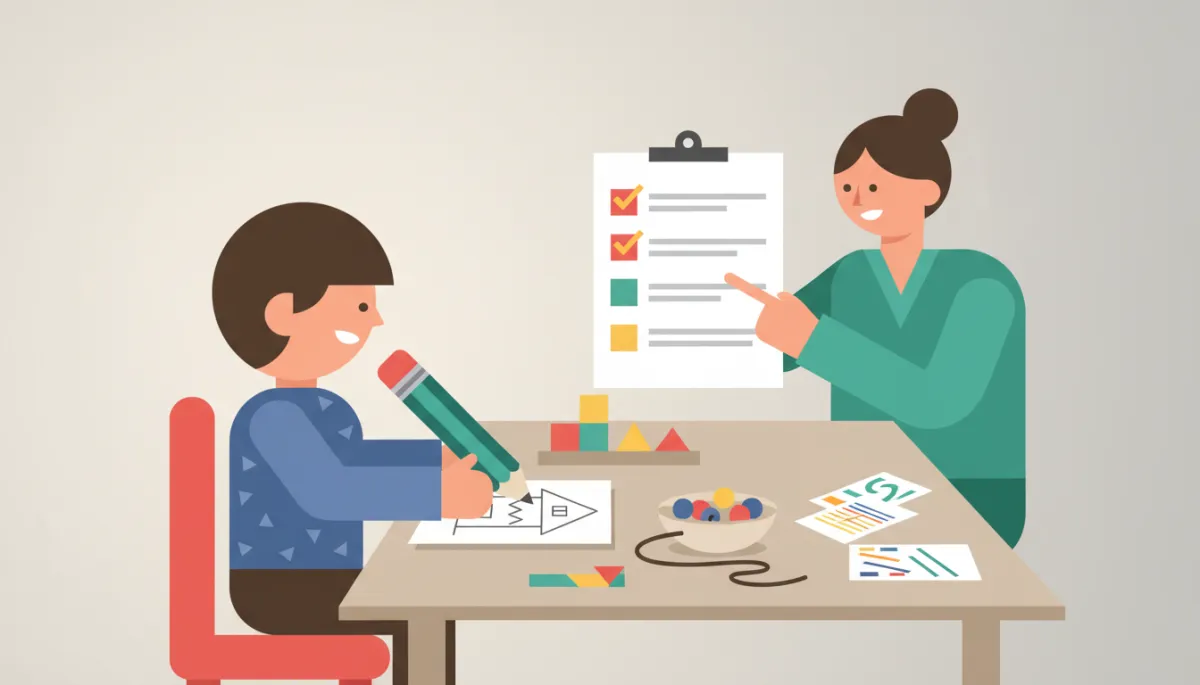
Comprehensive private OT evaluations connect test results to everyday routines and participation.
How Is a Private Evaluation Different From a School Evaluation?
School and private evaluations serve different purposes. The side-by-side guide School OT evaluation vs. private OT evaluation: What’s the difference? explains how purpose, scope, payment, and service decisions differ. The family typically selects and pays the private provider, while school evaluations are funded and directed by the district. Neither is automatically better. They serve different purposes and may evaluate different parts of the child’s life, with school focusing on educational access and private assessments often looking more broadly at daily functioning.
Sharing a Private OT Report With the School
A private report can be shared with the educational team, and the report can provide additional data to inform IEP or 504 planning. Yes. The report can provide additional data, but it does not automatically require the school to accept every conclusion or recommendation. The report can be considered, but the school does not automatically have to adopt every recommendation or change services solely based on a private opinion. A private evaluation also does not necessarily replace the district’s own evaluation responsibilities; the school may still evaluate your child to meet its legal obligations.
Private OT vs. IEE: Which Path Should You Choose?
If you disagree with an existing district evaluation, investigate the IEE process first. If you disagree with the district evaluation, pause before paying privately. An Independent Educational Evaluation (IEE) at public expense may be the more appropriate process when you believe the school’s evaluation is incomplete or inaccurate. Read IEE vs. private OT assessment: What’s the difference? to understand the legal and practical distinction before scheduling. Choose based on whether you simply want independent answers or disagree with an evaluation the district already completed.
What Does a Private Assessment Through Kerrie Rowe OT Emphasize?
At Kerrie Rowe OT, a private assessment is individualized around the questions the family needs answered. The purpose is not to administer every available test; it is to explain the child’s strengths, functional challenges, likely contributing factors, and practical next steps. This approach supports families who want a clear, functional picture that spans school, home, and community, along with specific private treatment recommendations and strategies they can begin using right away.
Key Takeaways for Families Considering Private OT Evaluation
You may obtain a private OT evaluation without school permission, and you can contact a private therapist directly.
Private assessments can examine skills across school, home, routines, self-care, play, and community participation for a broader functional picture.
The family typically selects and pays the private provider, while school evaluations are funded and directed by the district.
A private report can be shared with the educational team, but the school is not required to adopt every recommendation or replace its own evaluation.
When you disagree with an existing school evaluation, consider the IEE process before paying out of pocket for a private assessment.
For the full decision framework, review Pediatric OT evaluation options: School OT, private OT, and IEEs before choosing one path over another.
Educational notice: This page provides general information about pediatric occupational therapy evaluations and special education. It is not legal advice. Families should review their procedural safeguards and consult a qualified special education attorney or advocate when legal guidance is needed.