Pediatric OT: School, Private, and IEEs Options
Pediatric Occupational Therapy, School OT, Private OT, IEEs
Pediatric OT Evaluation Options: School OT, Private OT, and IEEs
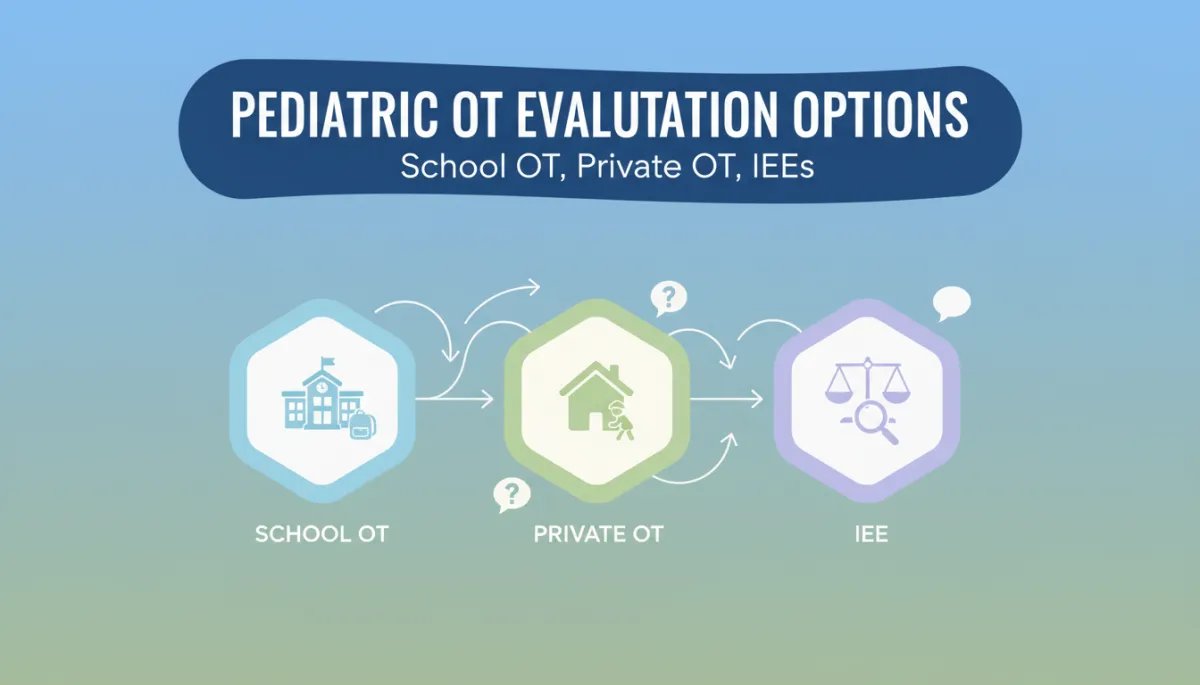
Parents generally have three evaluation paths: a school OT evaluation, a private OT assessment, or an Independent Educational Evaluation (IEE). The right path depends on whether you want the school to assess educational needs, want a broader private understanding of your child, or disagree with an evaluation the district has already completed. At Kerrie Rowe OT, I help families separate these options before scheduling anything, because choosing the wrong process can lead to duplicated testing, unnecessary expense, or a report that does not answer the question the family actually has.
Key Takeaways for Parents Comparing OT Evaluation Options
When you are deciding between a school OT evaluation, a private OT assessment, or an IEE, it helps to keep several core principles in mind.
A school OT evaluation focuses on educational participation and related-service needs.
A private OT evaluation can examine school, home, self-care, play, routines, and community participation.
An IEE is an independent evaluation connected to the special education process.
Parents may request an IEE at public expense when they disagree with a district evaluation, subject to IDEA requirements.
No single test score automatically determines school OT services for every child.
The best evaluation is the one designed to answer the family’s specific unresolved question.
What Are the Three Main Pediatric OT Evaluation Paths?
Evaluation path Best fit when Typical payer Primary focus School OT evaluation You want the district to evaluate educationally relevant OT needs School district Access, participation, and educational benefit Private OT evaluation You want a broader independent picture of your child Family or private payer Home, school, self-care, play, and routines OT IEE The district evaluated your child and you disagree with that evaluation Public agency when provided at public expense Independent educational evaluation of disputed or unanswered concerns

Matching the evaluation path to your question prevents duplicated testing and confusion.
What Happens When I Disagree with the School’s OT Evaluation?
Disagreement can mean the school tested the wrong areas, overlooked important parent or teacher concerns, relied too heavily on one score, or reached conclusions that do not match your child’s functional performance. For a step-by-step review of your options, read What if I disagree with my child’s school OT evaluation? It explains how to separate disagreement with the evaluation itself from disagreement with the IEP team’s service decision.
What If the School Says My Child Does Not Qualify for OT?
A school decision that OT is not required does not necessarily mean your child has no motor, sensory, handwriting, self-care, or regulation difficulties. School-based OT is tied to educational need, while private OT can address a wider range of functional concerns. The page What if the school says my child doesn’t qualify for occupational therapy? explains why a child may not receive school OT and what parents can do next.
Can I Choose a Private Evaluation Instead of Going Through School?
Yes. Families may independently obtain a private OT assessment without first waiting for a school evaluation. The private report can be shared with the school, but it does not automatically replace the district’s evaluation process or require the school to adopt every recommendation. Read Can I get a private OT evaluation instead of a school OT evaluation? when you want help deciding whether private assessment is the more direct starting point.
How Is an IEE Different from a Private OT Assessment?
Both may be completed by an independent occupational therapist, but an IEE has a defined role under IDEA. A private OT assessment is independently arranged by the family and does not require a prior district evaluation or disagreement. The detailed comparison in IEE vs. private OT assessment: What’s the difference? explains the differences in purpose, payment, criteria, and how each report is used.
How Is a School Evaluation Different from a Private Evaluation?
The biggest distinction is scope. A school evaluation asks how OT-related needs affect the educational program. A private assessment may also examine dressing, meals, homework, routines, play, sports, and independence outside school. Use School OT evaluation vs. private OT evaluation: What’s the difference? for a side-by-side explanation of scope, process, cost, and service decisions.
How Do California Parents Request an OT IEE?
A parent should generally identify the district evaluation they disagree with, make the request in writing, ask for the district’s current IEE criteria, and keep a dated record. Under federal rules, the district must act without unnecessary delay by providing the IEE at public expense or filing due process to defend its evaluation. The California-focused instructions and sample language are in How do I request an OT IEE from my school district in California? so parents can move from research to action without overcomplicating the request.
How Do I Select the Right Independent OT Evaluator?
A qualified evaluator should satisfy applicable district criteria, understand pediatric development and school-based OT, use individualized assessment methods, and remain independent rather than promising a particular result. Before contacting providers, use How do I choose an occupational therapist for an IEE? as a practical evaluator-screening checklist.
What Should an OT IEE Actually Include?
A meaningful OT IEE rarely consists of one test. Depending on the referral, it may include records, interviews, teacher input, observation, work samples, functional tasks, standardized testing, interpretation, and a comprehensive report. For a detailed assessment framework, read What assessments should be included in an occupational therapy IEE? which explains how testing should be selected and what warning signs suggest an evaluation may be too limited.
Is Another Evaluation Worth the Time and Effort?
An IEE is most valuable when it can answer a specific question the school evaluation did not resolve. It is less useful when it merely duplicates recent appropriate testing or is pursued only to obtain a predetermined recommendation. The decision guide Is an OT IEE worth it if my child already had a school evaluation? helps parents evaluate the likely value before moving forward.
How Do I Decide Which Evaluation Path Fits My Child?
Identify the main concern and where it occurs.
Determine whether the school has already completed an evaluation.
Decide whether you disagree with the evaluation, the service decision, or both.
Write down the exact question you still need answered.
Choose the process designed to answer that question.
When a family contacts Kerrie Rowe OT, I begin with those questions rather than assuming every child needs the same evaluation. The goal is not more testing. The goal is a useful, defensible explanation of the child’s strengths, challenges, functional impact, and next steps.
Frequently Asked Questions About Choosing an OT Evaluation Path
Should I start with a school OT evaluation or a private OT evaluation?
Start with the school when your main goal is educational evaluation and school-based support. Consider a private assessment when you want a broader understanding across school, home, routines, self-care, and everyday participation.
When should I request an OT IEE?
Investigate an IEE when the district has already evaluated your child and you disagree with that evaluation. Identify what was missed, inadequately assessed, or not explained.
Can I share a private OT report with the school?
Yes. Parents can provide private evaluation information to the educational team, but the school is not automatically required to implement every private recommendation.
Does an IEE guarantee school occupational therapy?
No. An IEE provides independent data that the team must consider when applicable, but it does not guarantee eligibility, direct OT, or a particular service frequency.
Who can help me decide which evaluation I need?
A pediatric occupational therapist familiar with school-based and private evaluation can review the situation and help clarify which process is most likely to answer the remaining questions.
Educational notice: This page provides general information about pediatric occupational therapy evaluations and special education. It is not legal advice. Families should review their procedural safeguards and consult a qualified special education attorney or advocate when legal guidance is needed.