Is an OT IEE Worth It After School Evaluation?
Occupational Therapy, Independent Educational Evaluation, Special Education
Is an OT IEE Worth It If My Child Already Had a School Evaluation?
An occupational therapy Independent Educational Evaluation (OT IEE) can be a powerful tool when a school-based evaluation leaves important questions unanswered. It can also be unnecessary when it simply repeats appropriate testing that has already been done. Understanding when an OT IEE adds value can help families make informed decisions before investing time, energy, or money in another assessment.
Is an OT IEE Worth Requesting After a School Evaluation?
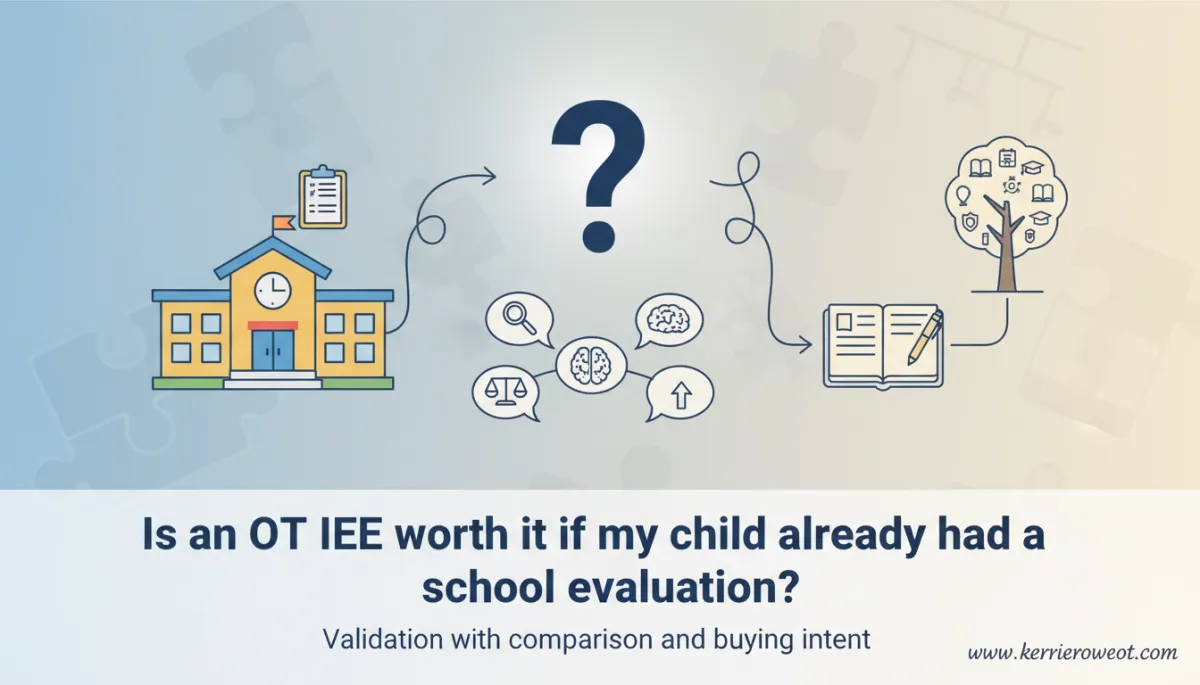
An OT IEE can be worth it when the school evaluation leaves important questions unanswered, misses a suspected area of need, relies on limited data, or does not reflect your child’s actual educational performance. It is less useful when it merely duplicates recent appropriate testing or is pursued only to secure a predetermined recommendation. In other words, the strongest reason for an IEE is a specific unresolved evaluation question, not simply disagreement with a service decision.
Comparing an OT IEE With Other Pediatric OT Evaluation Pathways
An OT IEE is only one of several evaluation options for children. Other common pathways include school OT evaluations and private OT assessments. To compare these options and decide whether another evaluation is the best next step, families can begin with Pediatric OT evaluation options: School OT, private OT, and IEEs . This broader overview can clarify when an educational IEE, a school reevaluation, or a private clinical assessment is the better fit for your goals.
When Is an OT IEE Most Likely to Add Value?
An IEE is most helpful when it can add missing data, functional interpretation, and an independent perspective. It is especially worth considering when:
Important areas were not assessed, such as sensory processing, motor planning, or functional school routines.
Testing and classroom performance do not match, and scores do not explain day-to-day struggles.
Parent or teacher concerns were not investigated in depth during the school evaluation.
The report relies heavily on one score instead of a range of data sources and observations.
Functional educational impact is unclear, and it is not obvious how the findings relate to school participation and learning.
Conclusions do not appear to follow from the data that were collected.

Independent evaluations add the most value when they explain day-to-day school functioning.
When Might an OT IEE Not Be Worth It?
There are also times when an IEE adds little. It may not be worth pursuing when:
You agree with the evaluation findings but dislike the service decision or frequency of OT.
The goal is only to obtain a recommendation for OT services, regardless of the data.
The proposed evaluator will repeat the same tests without a clear reason or added perspective.
No specific unanswered question can be identified beyond general dissatisfaction.
The evaluator promises a predetermined outcome, such as guaranteed eligibility or services.
How Can I Evaluate the Likely Value of an OT IEE?
Before moving forward, it can be helpful to pause and assess whether an IEE is likely to answer the concern you have. Consider these steps:
Identify exactly what you disagree with in the existing evaluation or what feels incomplete.
Write the unanswered question in one clear sentence, such as, “Why does my child struggle to write legibly in class when testing was average?”
Determine what new data could reasonably answer that question, such as observations, different standardized tools, or functional school-based tasks.
Confirm that the evaluator has the right expertise to address your child’s suspected areas of need and the educational context.
Be prepared for an independent result, even if it agrees with some or all of the district’s findings.
📌 Key Takeaway: An IEE offers the most value when it is designed to answer a specific, well-defined question that the school evaluation did not resolve.
How Do I Choose an Occupational Therapist for an IEE?
If you decide to move forward, the next step is selecting an evaluator who is both qualified and independent. How do I choose an occupational therapist for an IEE? outlines how to compare providers based on training, experience with school-based needs, scope of assessment, and independence from the district. A strong evaluator focuses on answering the agreed-upon questions rather than promising specific services.
Will an OT IEE Automatically Change My Child’s IEP?
No. An IEE does not automatically determine eligibility, service frequency, goals, or placement. The IEP team must consider qualifying IEE information when it is applicable, but the evaluation itself does not guarantee school OT or require the team to adopt every recommendation. In some cases, the evaluator may agree with the school’s conclusions, which can still provide clarity or reassurance that the existing evaluation was appropriate.
Could a Private OT Assessment Be More Appropriate?
Yes. A private assessment may be a better fit when your main goal is a broader understanding of home routines, self-care, play, or private treatment options rather than disagreement with a district evaluation. In these situations, it may not be necessary to use an educational dispute process to answer a primarily clinical question. The distinctions in IEE vs. private OT assessment: What’s the difference? can help you decide whether an educational IEE or a private clinical evaluation best matches your needs.
How Does Kerrie Rowe OT Help Families Judge Value?
Kerrie Rowe OT begins by reviewing the existing evaluation and the concern that remains unanswered. I do not recommend an IEE simply because a parent wants a different conclusion. Instead, I recommend independent evaluation when it has a reasonable chance of adding meaningful information, clarifying functional impact, or resolving a specific question about your child’s educational needs. Families are also encouraged to investigate their rights to request an IEE at public expense before choosing to pay privately.
Frequently Asked Questions About OT IEEs
Is an IEE worth requesting after a school evaluation?
It can be when a specific unresolved concern can be meaningfully investigated through independent assessment, rather than a general desire for more services.
Will an IEE help my child qualify for OT?
It may provide useful evidence, but it does not guarantee school OT or any particular level of support. The IEP team remains responsible for eligibility and service decisions.
Is an IEE worth it when school testing was average?
Possibly. An IEE may be helpful if the evaluation does not explain significant functional difficulties or clear discrepancies between scores and classroom performance, even when scores fall in the average range.
What if the IEE agrees with the school?
That is possible and still can be valuable. Agreement may validate that the existing evaluation was appropriate, provide clearer explanations, or offer more detailed recommendations for supporting your child at school.
Should I pay privately for the IEE?
Before paying privately, determine whether you can request an IEE at public expense based on disagreement with the district evaluation. Reviewing your procedural safeguards and seeking guidance from a qualified special education advocate or attorney can help you understand your options.
Educational notice: This page provides general information about pediatric occupational therapy evaluations and special education. It is not legal advice. Families should review their procedural safeguards and consult a qualified special education attorney or advocate when legal guidance is needed.
To learn more or explore whether an OT IEE is the right next step for your child, visit Is an OT IEE worth it? for additional guidance and resources.