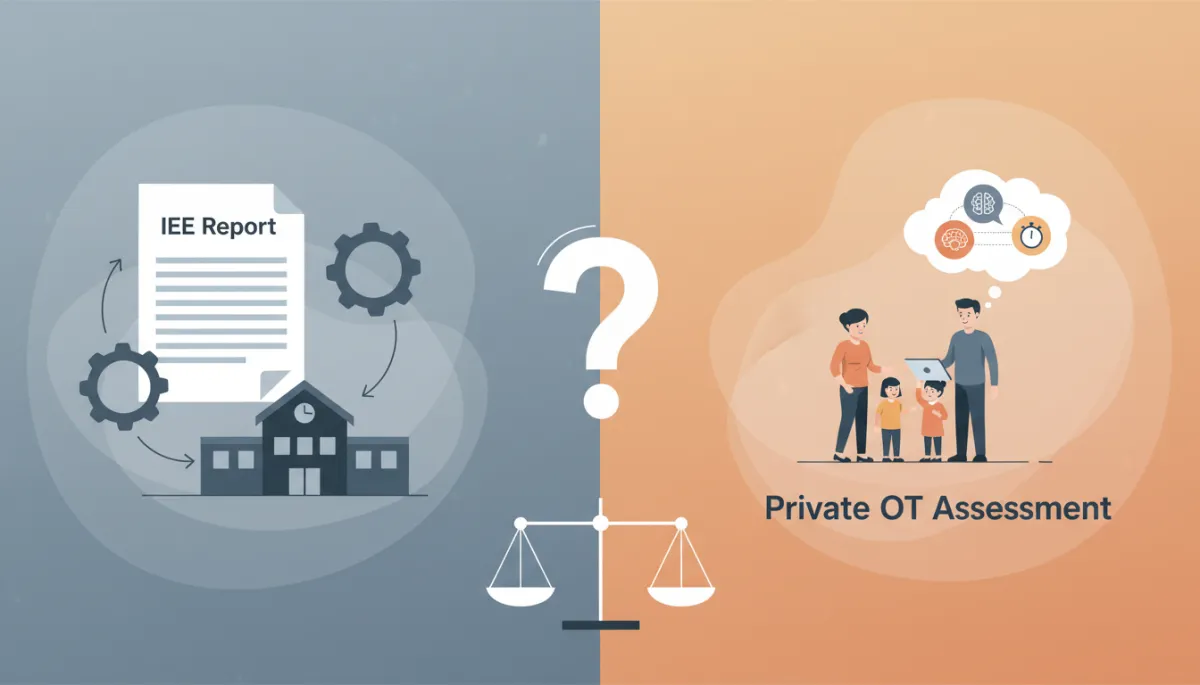
IEE vs Private OT Assessment: Key Differences
Pediatric OT, School Evaluations, Independent Educational Evaluations
IEE vs. Private OT Assessment: What’s the Difference?
An OT IEE is an independent evaluation connected to the special education process, while a private OT assessment is independently arranged by the family. If the district evaluated your child and you disagree, investigate an IEE; if you simply want a broader understanding of your child’s OT needs, a private assessment may be the better fit.
Key Differences at a Glance
This comparison is one branch of the larger framework in Pediatric OT evaluation options: School OT, private OT, and IEEs which also explains when a school evaluation is the correct starting point. At the core, an OT IEE and a private OT assessment are both comprehensive evaluations, but they arise from different situations and follow different rules.
Question OT IEE Private OT assessment Why is it happening? Parent disagrees with district evaluation Family wants independent answers Prior school evaluation required? Generally yes for the public-expense disagreement right No Typical payer Public agency when provided at public expense Family or private payer District criteria May apply Not generally required to obtain private assessment Primary context Special education and educational participation Broader occupational performance
What Is an OT IEE Under IDEA?
An IEE has a specific meaning under IDEA. In this context, an occupational therapy IEE is an Independent Educational Evaluation requested when a parent disagrees with a school district’s special education evaluation. The evaluation is conducted by a qualified examiner who is not employed by the district, but the findings are still part of the special education process and are considered by the IEP team.
An IEE at public expense is paid for or provided at no cost to the parent by the public agency, as long as the request meets the legal requirements. Generally, a prior school evaluation is required before parents can exercise their disagreement rights and request an IEE at public expense.
What Is a Private OT Assessment?
A private OT assessment does not require a prior school evaluation. Families can independently arrange this type of assessment at any time, whether or not the child is being evaluated for special education. Private evaluations are typically family-paid or privately reimbursed through insurance or other funding sources, and they are not bound by school district criteria for eligibility.
Choose a private assessment when you want broader information about handwriting, sensory regulation, motor skills, self-care, routines, play, homework, or independence without disputing a district evaluation. For a direct comparison with the school process, read Can I get a private OT evaluation instead of a school OT evaluation? before deciding which route is more efficient for your situation.

Both IEEs and private OT assessments use similar tools but serve different purposes.
What Do the Assessments Include, and Do They Guarantee Services?
In practice, there may be substantial overlap between an OT IEE and a private OT assessment. Both may include records, interviews, observations, standardized testing, and recommendations. The difference is not the brand of test but the referral question, context, interpretation, and how the findings are used. The guide What assessments should be included in an occupational therapy IEE? explains why a comprehensive IEE should include more than one standardized score.
Neither option guarantees school-based OT services. Both can provide data and recommendations, but the educational team still makes school-service decisions based on eligibility rules and educational impact. A strong report can clarify needs and support collaborative planning, but it does not automatically result in school OT.
When Should I Investigate an IEE?
Investigate an IEE when the district completed an evaluation and you believe it missed an area, failed to explain functional performance, or reached unsupported conclusions. This is especially relevant if the evaluation does not match what you see at home, does not address participation in school routines, or does not provide clear recommendations.
The action steps are detailed in How do I request an OT IEE from my school district in California? including what to put in writing and what criteria to request. If you disagree with the school, investigate the IEE process before automatically paying privately.
How Can Kerrie Rowe OT Help Families Decide?
Kerrie Rowe OT begins with a records-and-concerns review so the family can determine whether the issue calls for an IEE, a private OT assessment, or another conversation with the school team. That prevents the evaluation from starting under the wrong framework and helps families align their next steps with their goals, timelines, and resources.
Frequently Asked Questions
Is an IEE the same as a private OT evaluation?
No. An IEE is part of the special education evaluation process; a private OT assessment is independently arranged by the family.
Who pays for an OT IEE?
When provided at public expense, the public agency pays or ensures there is no cost to the parent.
Can I get a private OT assessment without school involvement?
Yes. Families may pursue a private OT assessment at any time, regardless of school evaluation status.
Which option should I choose if I disagree with the school?
Investigate the IEE process before automatically paying privately. An IEE may provide a path to an independent opinion at public expense when the legal criteria are met.
Will either evaluation guarantee school OT?
No. Both may clarify needs and offer recommendations, but school OT decisions are made by the educational team under special education rules.
Educational notice: This page provides general information about pediatric occupational therapy evaluations and special education. It is not legal advice. Families should review their procedural safeguards and consult a qualified special education attorney or advocate when legal guidance is needed.