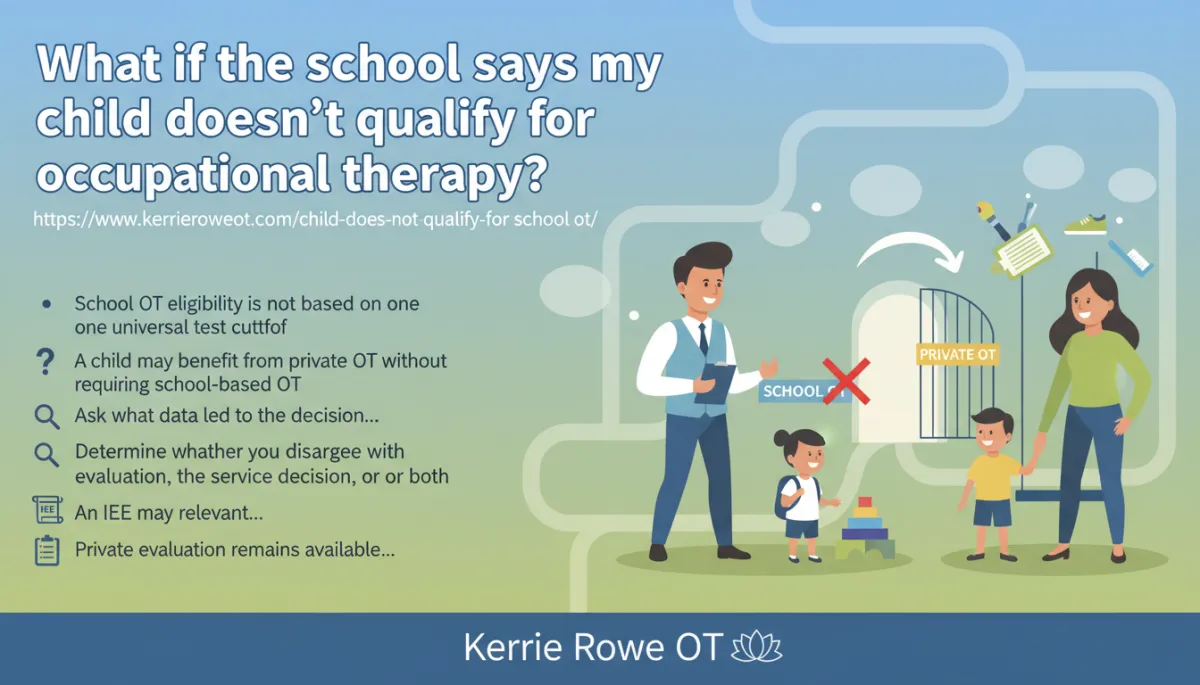
School OT Eligibility vs. Private OT Options
Pediatric Occupational Therapy, School OT Eligibility, Private OT
What if the School Says My Child Doesn’t Qualify for Occupational Therapy?
If the school says your child does not qualify for occupational therapy, it does not automatically mean your child has no OT-related difficulties. School-based OT is tied to educational need and the child’s special education program, while private OT can address broader concerns across home, school, self-care, play, and routines.
Understanding What “Not Eligible” Really Means
When a school team decides that a child does not qualify for occupational therapy, families often feel confused or worried. The decision can sound final, but it is actually a specific answer to a specific question: whether OT is required as a related service for your child to access, participate in, and benefit from their educational program. It is not a judgment on your child’s worth, your concerns, or the value of OT in other settings.
Why Might the School Say No to Occupational Therapy?
The school is not simply deciding whether OT could help. Many children could benefit from OT in some way. Instead, the educational question is whether OT is required for the child to access, participate in, and benefit from the educational program and the services outlined in the Individualized Education Program (IEP) or Section 504 plan. If the team believes your child’s needs can be addressed through classroom strategies, accommodations, or other supports, they may conclude that OT is not necessary as a school-based related service, even when OT-related difficulties are present.
Does My Child Need a Low Score to Receive School OT?
School OT eligibility is not based on one universal test cutoff. No single percentile automatically determines services for every child. Standardized scores are only one part of the picture. They should be interpreted alongside classroom performance, work completion, independence with school tasks, teacher input, observations, and other relevant data. A child can have scores in the average range yet still experience meaningful challenges in the classroom, just as a low score does not always translate into an educational need for OT services in that setting.
Key Questions to Ask the School Team
When OT is not recommended, it is appropriate to ask for a clear explanation of the decision. Consider asking the team:
Which needs were identified?
How are those needs affecting educational performance?
Why is OT not considered necessary?
What supports will address the difficulty instead?
What data will be monitored?
When will the team review progress?
💡 Pro Tip: Clarify whether you disagree with the evaluation, the decision not to provide OT, or both. This distinction guides your next steps.
What if I Believe the Evaluation Missed Something?
Sometimes families feel that the written report does not fully explain their child’s struggles, or that a relevant area was not assessed. In that case, your concern may be with the evaluation itself rather than only the service decision. It can be helpful to review the report and compare it with what you see at home and what teachers describe. The broader guide, Pediatric OT evaluation options: School OT, private OT, and IEEs, explains how this school decision fits within the three main evaluation pathways. You can also read What if I disagree with my child’s school OT evaluation? to identify the specific type of disagreement and the options available afterward.

A careful review of the full evaluation often clarifies what was assessed and what remains unanswered.
Can My Child Still Receive Private OT?
Yes. A child may benefit from private OT without requiring school-based OT. Private occupational therapy is not limited by the school’s related-service decision and can address a broader range of functional skills across settings. This may include handwriting, fine motor skills, sensory regulation, motor coordination, dressing, self-care, homework, and daily routines. The page School OT evaluation vs. private OT evaluation: What’s the difference? explains why the two systems can reach different but not necessarily contradictory conclusions.
Should I Request an Independent Educational Evaluation (IEE)?
An Independent Educational Evaluation (IEE) may be appropriate when the district evaluated your child and you disagree with that evaluation. It is not automatically the correct response to every denial of OT. An IEE can provide another professional opinion about your child’s needs and how they affect education. However, it is most useful when you can clearly describe what you believe was missed or not fully addressed. The resource Is an OT IEE worth it if my child already had a school evaluation? can help you decide whether another independent evaluation is likely to add meaningful information.
How Does Kerrie Rowe OT Approach This Situation?
At Kerrie Rowe OT, the process begins by clarifying what your child is struggling with, what the school assessed, and what remains unexplained. This includes reviewing the school evaluation, relevant reports, and your observations at home. Sometimes the next step is an IEE to take a deeper look at school-related skills. Sometimes a private assessment focused on home, self-care, and community participation is more appropriate. In other cases, the most helpful step is a more focused conversation with the educational team to adjust supports, clarify data, or plan a trial period of specific strategies. The goal is to select the pathway that adds the most meaningful information and support for your child, rather than pursuing every possible option at once.
Frequently Asked Questions
Why would my child not qualify for school OT?
The team may determine that OT is not required within the child’s educational program even though some OT-related difficulties exist. They may believe that other supports, accommodations, or classroom strategies are sufficient for your child to access and benefit from instruction.
Can my child get private OT after the school says no?
Yes. Private OT has a broader functional scope and is not limited by the school’s related-service decision. It can support skills across home, school, play, and daily routines, even when school OT is not provided.
Does an average score mean my child does not need OT?
Not automatically. Scores should be considered alongside real-world performance and educational impact. A child with “average” scores can still face meaningful challenges with handwriting, organization, sensory regulation, or independence that justify support in other settings.
Can I request an IEE after OT is denied?
Possibly. An IEE may be relevant when the denial follows a district evaluation with which you disagree. It is important to review your procedural safeguards and understand the local process for requesting an IEE.
What should I do first?
Start by obtaining the full written evaluation, asking the team to explain the decision, and identifying what concern remains unanswered. From there, you can decide whether additional school discussion, private OT, or an IEE is the most appropriate next step.
Educational Notice
This page provides general information about pediatric occupational therapy evaluations and special education. It is not legal advice. Families should review their procedural safeguards and consult a qualified special education attorney or advocate when legal guidance is needed. For more detail on how school OT, private OT, and IEEs fit together, you can visit What if the school says my child doesn’t qualify for occupational therapy?.