
Understanding Your Child's Sensory Seeking Behavior
Child Development, Sensory Processing, Parenting Support
Why Does My Child Constantly Seek Movement, Crash Into Things, or Play Too Rough?
A child who constantly jumps, crashes, spins, wrestles, chews, or seeks intense movement may be seeking additional sensory input, particularly vestibular or proprioceptive input. Sensory seeking is only one possible explanation, so it is important to consider how often the behavior happens, what triggers it, whether it is safe, and how it affects everyday participation.
Key Takeaways for Parents and Caregivers
When a child seems to be “always on the move,” it can be confusing or worrying. Understanding what might be happening underneath the behavior can help you respond more effectively and protect both safety and participation in daily life.
Sensory seeking can look like constant movement, crashing, chewing, touching, or rough play.
Proprioception provides information from muscles and joints about body position and force.
Vestibular processing relates to movement and balance.
Sensory-seeking behavior is not automatically a disorder and can also appear in typical development.
ADHD and sensory-seeking behaviors can overlap, but one does not automatically mean the other.
Intervention should support successful participation rather than simply trying to stop a child from moving.
What Does Sensory Seeking Look Like?
Many parents describe children who seem driven to move or crash. Common examples include children who:
Jump repeatedly, even when asked to stop
Crash onto furniture, pillows, or the floor
Push or pull heavy objects during play or chores
Wrestle frequently with siblings or caregivers
Spin, hang upside down, or seek fast movement
Chew pencils, clothing, or other non-food objects
Touch everything in the environment or hug with excessive force
Have difficulty remaining seated for meals, schoolwork, or group activities
These behaviors can have different causes. For some children, they are primarily related to sensory processing. For others, they may be connected to attention, impulse control, developmental stage, or a combination of factors. If these terms are new to you, the broader guide to Sensory Processing Disorder in children explains proprioception, vestibular processing, sensory seeking, sensory avoiding, and when sensory behaviors may affect a child's daily function.
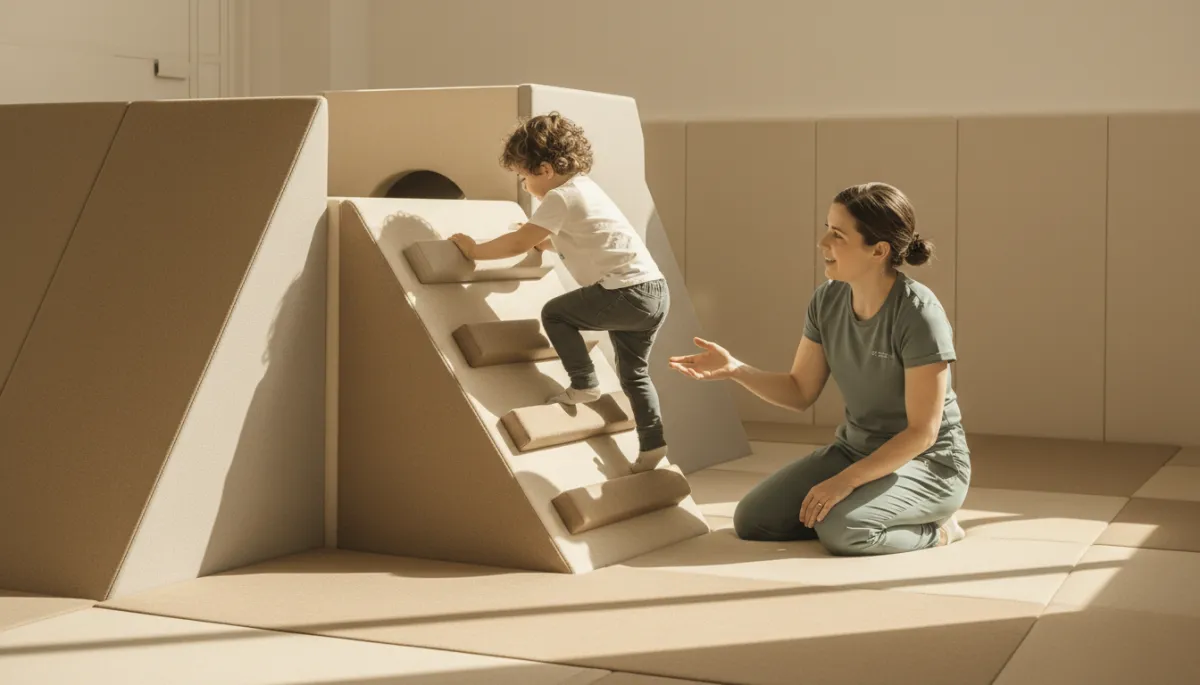
Purposeful movement can channel sensory needs while supporting safe, meaningful participation.
What Is Proprioceptive Input?
Proprioception provides the brain with information about body position and force through receptors associated with muscles and joints. This internal “body map” helps a child know how hard to push, how high to jump, and where their body is in space without constantly looking.
Activities involving pushing, pulling, climbing, carrying, squeezing, resistance, and jumping provide proprioceptive information. Some children appear to actively seek large amounts of this input. That may help explain why a child repeatedly crashes onto the couch, hugs with surprising force, or constantly wants to wrestle. For these children, strong proprioceptive input may feel organizing, calming, or simply satisfying.
What Is Vestibular Input?
The vestibular system helps process movement and balance. It responds to changes in head position, speed, and direction. Everyday activities such as running, swinging, spinning, jumping, climbing, and hanging upside down all involve vestibular information.
Children can respond very differently to vestibular input. One child may avoid swings or feel nauseated by spinning. Another seems like they could swing forever without appearing dizzy. This wide range of responses is one reason generic sensory recommendations do not work equally well for every child. Observing your child's individual reactions is more helpful than relying on a one-size-fits-all list of activities.
Could Constant Movement Actually Be ADHD?
Possibly. Constant movement can occur with sensory seeking, ADHD, normal development, other developmental differences, or combinations of factors. Instead of assuming movement automatically equals ADHD, it is more useful to look at the broader pattern of behavior across settings and activities.
Helpful questions include:
Does movement increase in certain environments, such as busy classrooms or crowded stores?
Does movement appear to improve the child's ability to participate, or does it disrupt tasks further?
Is the child also having difficulty with attention and impulsivity across multiple settings, such as home and school?
Because these behaviors overlap so frequently, Sensory Processing Disorder vs. ADHD: How can parents tell the difference? explains why the same outward behavior can have several possible explanations and why a thorough evaluation is often needed.
Should I Try to Stop My Child from Moving?
Not automatically. Movement itself is not the enemy. In many cases, movement helps a child stay alert, regulate emotions, and prepare for tasks that require focus. Sometimes a better question is: Can we give this child an appropriate way to move while still accomplishing what needs to happen?
For example, a child who benefits from movement before homework may participate better after active play than after being repeatedly told to “sit still.” The goal is not movement versus no movement. The goal is successful participation in daily routines such as school, play, family time, and self-care, while maintaining safety for the child and others.
What Can I Do at Home?
Depending on the child's age and abilities, ordinary active play can provide valuable sensory input. This might include playground activities, climbing, outdoor play, movement before seated tasks, pushing and pulling during play, or appropriate physical household activities such as carrying laundry or helping move light items.
The strategy should always have a purpose. Rather than adding random activities, consider what you hope the movement will support: improved focus, calmer transitions, safer roughhousing, or better sleep routines. For a more structured way to experiment with routines, How can I help a child with sensory issues at home without making things worse? explains how to observe triggers and responses before adding sensory activities.
💡 Pro Tip: Track when movement helps and when it escalates behavior. Simple notes about time of day, activity, and response can guide more targeted support.
When Should I Be Concerned About Constant Movement?
Movement deserves a closer look when it is unsafe, extremely intense, difficult to redirect, interfering with learning or peer relationships, or preventing participation in everyday activities. Examples include frequent injuries, aggression during rough play, constant disruption in the classroom, or inability to join family routines such as meals or outings.
When these patterns occur, consulting with a pediatrician and, when appropriate, an occupational therapist can be helpful. When these behaviors are viewed through Kerrie Rowe OT or a similar professional lens, the goal is not to eliminate a child's need to move. Instead, the focus is on determining whether movement is helping the child regulate or whether the pattern is interfering with safety, learning, play, and family routines.
Frequently Asked Questions
Why Does My Child Purposely Crash Into Things?
Some children appear to seek strong proprioceptive or movement input. Crashing provides substantial body feedback, which may feel organizing or enjoyable. However, sensory seeking is not the only possible explanation, so it is important to consider safety, frequency, and impact on daily life.
Why Does My Child Always Need to Move?
Movement can support alertness and regulation. Persistent movement can also relate to sensory processing, attention, development, or other factors. Observing when movement helps and when it gets in the way of participation can guide whether additional assessment is needed.
Does Sensory Seeking Mean ADHD?
No. Sensory seeking and ADHD behaviors can overlap, but sensory seeking alone does not establish ADHD. A comprehensive evaluation that considers attention, impulsivity, sensory processing, and functioning across settings is needed to clarify the picture.
When Is Sensory Seeking a Problem?
Sensory seeking deserves a closer look when the behavior becomes unsafe, unusually intense, difficult to redirect, or consistently interferes with learning, play, relationships, or daily activities. In those situations, professional guidance can help you develop strategies that protect safety while respecting the child's need for movement and sensory input.